Spectrum of care practice
Complaints to the Board about diagnosis or the clinical management of animals are assessed on a case-by-case basis.
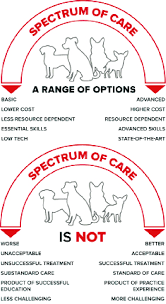
Rather than assessing whether a veterinary practitioner met a “gold standard” or provided “state of the art” care, the Board’s general approach is to assess whether a vet not only considered available evidence-based medicine but was also responsive to the context of the case and discussed a spectrum of care options with the owner.
The Board will look at whether a vet considered relevant contextual factors in their approach to diagnosis and clinical management, clearly communicated a continuum of diagnostic and care options to the animal's owner, and documented that discussion sufficiently.
The Board's approach aligns with the new Day One Competencies for veterinary graduates developed by the Australasian Veterinary Boards Council in (AVBC, 2024). These competencies describe the knowledge, skills, values, and attitudes veterinarians must possess from the first day of their professional careers.
Day One Competency Number 7 expects that a vet should be able to ‘tailor the diagnostic, treatment, preventive, and control plans when providing veterinary services, considering animal welfare, client expectations and economic contexts. They must be mindful of the welfare of the patient(s), whether for an individual animal or a group of animals. They should be able to contextualise and customise the patient’s diagnostic, treatment and preventive health plans and provide a spectrum of care when there may be financial or other constraints.’
Using a “spectrum of care” approach is not new, but it has become more central to veterinary practice as more pet owners struggle with the cost of living. In recent years, there have also been efforts to integrate spectrum of care practice into the veterinary school curriculum.
Contextual factors that may assist a vet to tailor appropriate care options include:
- the animal's wellbeing and welfare, e.g. the animal's individual characteristics and temperament, their symptoms and their quality of life (clients may be able to afford treatment but is treatment likely to be futile?)
- client/owner factors, e.g. their financial resources (to meet initial and long-term costs), their ability to comply with the logistics of treatment (including time factors), their values and beliefs, expectations, and care goals
- veterinarian factors, e.g. their knowledge and skills
- practice factors, e.g. expertise and availability of equipment, and
- scientific evidence and professional guidelines..
Based on these factors, the range of care options a vet presents to and develops with a client will vary. Along the continuum of acceptable care, a vet and their client may consider multiple options from more conservative and less expensive approaches
including less intensive diagnostic workup and symptomatic treatment, through to more intensive, usually more expensive, state-of- the-art diagnostics and treatment.
While the aim is for both vet and client to have input in deciding the best possible plan for the animal, the vet is responsible for advising the client of::
- the advantages, disadvantages, and most likely outcomes for each option presented
- the possibilities of favourable and unfavourable outcomes
- whether additional testing or treatment might be needed
- the strength of the supporting evidence for each option, and the costs associated with each option.
A vet can provide this information to a client in small sections, pausing to check whether the client understands the information presented.
In ‘Spectrum of care: more than treatment options’, Dr Carolyn Brown et al say, ‘How care options are presented can be as important as which care options are presented.’
A client-centred approach, where the vet asks the owner open-ended questions and actively listens, may help the owner to share important information about the context.
When communicating with a client about care options, Dr Brown says, ‘veterinarians should empower owners to choose the care option that best fits their expectations and financial considerations, without making them feel they are failing their pet if the most intensive, most expensive or most technologically advanced option is not chosen.’
She continues, ‘For many conditions, there is not a single treatment option that will routinely result in the best outcome... and many factors play a role in determining which outcome (e.g. survival time vs quality of life) is the “best” outcome and which care option is truly the best option for any specific patient and its owner.’
While conversations around choices for clinical management of an animal can be challenging and do take time, veterinary practitioners, animal owners and animals should all benefit when care options are discussed in context.
If you and your veterinary team are interested in learning more about the spectrum of care concept, the resources below include example cases and communication tips.
More information
Spectrum of care resources:
- AVBC Day One Competencies
- Brown et al, 2021, Spectrum of care: more than treatment options, Journal of the American Veterinary Medical Association (JAVMA), Volume 259, Issue 7, 712-717
- Boatright, What is the spectrum of care? NewSTAT 2022 and Embracing spectrum of care to promote early-career veterinary wellbeing MentorVet 2023
- Quain, Ward and Mullan, 2021, Ethical Challenges Posed by Advanced Veterinary Care in Companion Animal Veterinary Practice, Animals, 11 (11) 3010
Relevant guidelines:
Other Board articles: