Prescription, supply and storage of compounded medicines
NOTE: The information in this article applies to treatment of individual patients. For herd animals, additional restrictions may apply under the Agricultural and Veterinary Chemicals (Control of Use) Act 1992 and other legislation.
Compounded medicines may be appropriate, and sometimes necessary, when other pathways to access medicines are not suitable for a patient.
They are usually prepared “extemporaneously” by a pharmacist or veterinarian, meaning they are prepared for an individual animal in response to a specific identified need shortly after presentation. In Victoria, compounded medicines can also be purchased and
stored for a future episode of patient care (see more information below).
Board guidance and legal framework
While compounded medicines are not specifically referred to in the Board’s Guideline 14: Supply and use of veterinary medicines, the guideline applies to both compounded and registered medicines. This means there must be an established veterinary practitioner-owner-animal relationship, the animal must be under the care of a vet, and there must be a therapeutic need for the medicine.
Both Commonwealth and Victorian laws allow the compounding of veterinary medicines. Under the Agricultural and Veterinary Chemicals Code (AgVet Code) a medicine does not need to be registered by the Australian Pesticides and Veterinary Medicines Association (APVMA) if it is compounded by a veterinarian or by a pharmacist after receiving instructions from a vet.
When not to compound a medicine
There is longstanding guidance about when compounding is not appropriate, including if:
- a registered veterinary medicine already exists, is available and appropriate for the animal. These can be checked on the APVMA PubCRIS database or Australian Register of Therapeutic Goods (ARTG).
- there is no evidence that the compounded medicine is a safe and appropriate treatment the vet does not have the right equipment and required knowledge and skills to compound the medicine safely for animals
- a pharmacy will be involved, but the pharmacist does not have the equipment, knowledge and skills to compound the medicine safely.
Guidelines for pharmacies and veterinarians
When a vet issues a prescription for a pharmacist to supply a compounded medicine, the pharmacist must follow the Pharmacy Board of Australia’s Guidelines on compounding of medicines (issued October 2024).
This is reinforced in the Australian Veterinary Association’s (AVA’s) policy, Veterinary use of compounded pharmaceuticals and its guidelines for the preparation and use of compounded pharmaceuticals (2020). These guidelines contain essential information
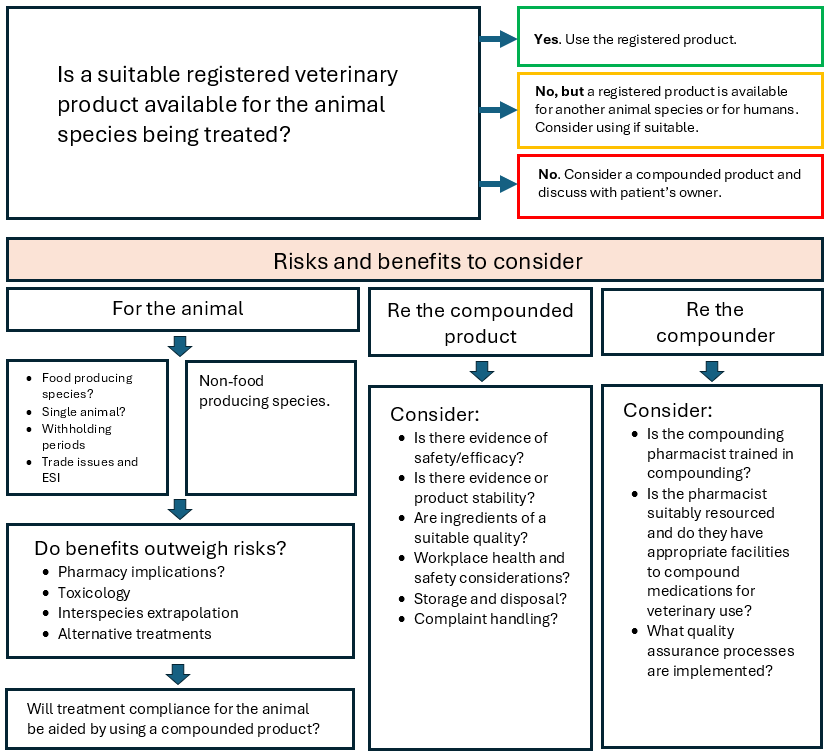
on the preparation, labelling and pricing and wholesaling of compounded medicines by vets or pharmacists. The decision flow chart in the guidelines (reproduced below) may help vets decide if, when and how to use compounded medicines.
Obtaining and storing compounded medicines
The AVA’s guidelines recommend that, where practicable, compounded medications should be ordered by prescription for individual patients.
However, the AVA acknowledges there are situations in which a veterinarian might need to order compounded medications for multiple animals such as reasonably foreseeable emergency use or treatment of multiple animals of the same owner.
Victoria’s Drugs, Poisons and Controlled Substances Act 1981 and Drugs, Poisons and Controlled Substances Regulations 2017 do not restrict or limit the quantity of compounded (unapproved) scheduled medicines that a registered veterinary practitioner may obtain or possess.
The Victorian Department of Health advises that a registered veterinary practitioner may purchase and store compounded medicines for use in a future episode of patient care, provided they are administered or supplied when a therapeutic need arises.
The Board does not intend to issue a separate guideline on compounded medicines and advises veterinary practitioners to consult the decision flow chart and resources below.
Decision flow chart for use of compounded medicines by veterinarians (AVA, 2020)
Please refer to the AVA guidelines for a full explanation of the process outlined below (reformatted for accessibility).
NOTE the considerations relating to pharmacists also apply to veterinary practitioners who are compounding medicines.
More information
Board guidance:
Australian Veterinary Association:
Pharmacy Board of Australia:
Agriculture Victoria: